Posts

A disciple-making community

Matthew 28.16-20 Summary: The risen Jesus commands us to be a disciple making, grace offering and teaching, learning, obedient people who by faith know that he is always with us It is good on this sort of occasion to go back to basics and to remind ourselves what sort of community we are called to be. And for that I have turned to the last few words of Matthew’s gospel and what is known as the great commission. The disciples have gathered together and Jesus has said to them: ‘All authority in heaven and earth has been given to me’. I guess that is easier to take from a man who has risen from the dead. Clearly Jesus has authority over the processes of nature and over death. And he has authority over the lives of men and women. God, by raising Jesus from the dead, has shown them that he is the Messiah, the One who He promised to send as his ruler, who has authority over all people and over all rulers. There is a booklet that has been produced about our Queen...
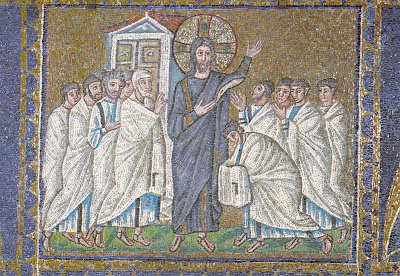
My Lord and my God

Image
John20.24-29 Today we are looking at the last in the cycle of very early C6th mosaics that can be found in the church of St Apollinare Nuovo in Ravenna, which depict the life, death and resurrection of Jesus.  We see Jesus appearing to the 11 disciples. This is the second meeting that the resurrected Jesus has with his disciples – a week after his appearance to them on the first Easter Sunday. Jesus is showing his wound (we only see the wound on his side, presumably where he was stabbed with the spear), but in so doing he points us to our right. All the way through this cycle of 26 mosaics, there has been a movement to our right. In most of the mosaics, one of the figures moves us on to the next. Now here at the end, Jesus himself moves us on, but this time upwards, to heaven. On the first occasion when Jesus appeared to his disciples, Thomas was not present. And when the disciples told Thomas that they had seen the Lord, Thomas made his famous statement: ‘Unless I s...

Hope is kindled!

Image
Luke 24.13-35 One of our boys talks in his sleep. We were on holiday, had been watching The Lord of the Rings , and were sharing a room in a B and B, when our comatose 12-year-old declared: ‘Don’t worry mummy. Hope is kindled!’ The resurrection of Jesus gives hope 1.       It gives hope to people who are crushed The first followers had lived for Jesus. They had put their trust in Jesus.  They had hoped that he was the Messiah. ‘We had hoped that he was the one who would redeem Israel’, say these two people as they walk on the road from Jerusalem to Emmaus. And the Messiah, for Jews, was the one who would come as God’s ruler. He would establish God’s kingdom of peace and justice. He would not die, but would bring an end to death. And when he reigned, those who had died would rise. There would be a general resurrection from the dead – some to eternal glory, some to eternal shame. These followers had staked their life on the convic...

When confusion gives way to joy. Easter Sunday 2016

Luke 24.1-12 The first consequence of Easter morning was not joy but confusion. You see we live in a universe that appears to be ruled by death. We come from dust and we return to dust. And if the current cosmological theories are right we live in a universe that began in darkness and nothingness and that will end in darkness and death. And we learn to live with it. We will live, we will do stuff, stuff will be done to us and then we will die. And that is it. ‘Life’, said Ernest Hemingway, ‘is a dirty trick. A short trip from nothingness to nothingness’. And as far as the dead are concerned: We remember them. There is a great line in the film, ‘Good Night, Mr Tom’. The boy is grieving for his friend who has been killed in the blitz. He can’t get over it. So Mr Tom takes him down to the grave of his wife. ‘Look’, he says, ‘They do not die. They live on. In here. In your heart. In your memory. ‘ Yes, we remember the dead. And we honour the dead. ...

Are we free to speak?

Image
A legal, historical, philosophical and biblical look at the subject of freedom of speech. Click here For  ​ ​further consideration on the subject, Mike Ovey has written a very helpful article on free speech:  Is the Wrath of God Extremist? [ Themelios 40.3 (2015): 389–391 ]   

The king who comes to bring peace.

Mark 11.1-11 Today we remember and we give thanks for that day when the king rode into his city. He is the King, the Messiah That is so clear in Mark’s gospel. This is the first time that I have noticed this, but Mark does not quote Zechariah 9.9. Zechariah 9.9 is the prophecy that the Messiah, God’s King, will enter Jerusalem riding on the colt of a donkey. ‘Rejoice greatly, O daughter Zion! Shout aloud, O daughter Jerusalem! Lo, your king comes to you; Triumphant and victorious is he, Humble and riding on a donkey, On a colt, the foal of a donkey.’ Matthew quotes Zechariah 9.9; John quotes the first part of Zechariah 9.9. But Mark does not. A Gentile, a non-Jew, as they heard this read, would completely miss the reference to the idea that Jesus was fulfilling prophecy, or that Jesus was coming as a humble king. What they would hear is something very different: God's King is coming to God's city. 1.        ...

Who is your true mother?

Galatians 4.21-31 Paul writes, ‘The other woman corresponds to the Jerusalem above; she is free and she is our mother’ (Galatians 4.26) It is strange language. Why not ‘home’? It would make more sense But when Paul talks about ‘our mother’, he is speaking of our origins. Our understanding of our origins is vitally important. It shapes our self-understanding, and our understanding of other people. That is why programmes like ‘Who do you think you are?’ are so fascinating. It is why many people research their family histories. In our society we usually look for our origins through the paternal side. But for the Jew, origins are traced through the maternal side. I am a Jew not if my father is a Jew, but if my mother is a Jew. So when Paul wants to remind Christians that we are not children of this world, but children of that world; that we are not children of biological necessity, but children of the promise of God, he asks us to think through the question, ...