Posts

Showing posts with the label godly living

What happens when we run out of wine?
Image
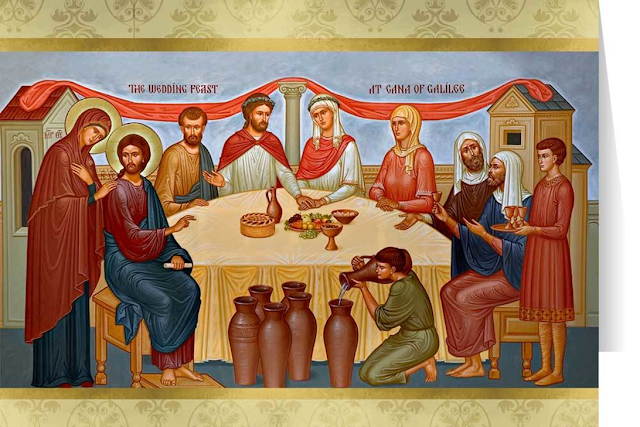
John 2.1-11 Later in the service, at the prayer before we distribute the bread and wine, we will hear the words, ‘In the water made wine the new creation was revealed at the wedding feast. Poverty was turned to riches, sorrow into joy’. That is what Jesus is doing when he turns water into wine. He takes one of the key elements of life – the ancients had four key elements: earth, water, air, fire (I’d have done a lot better in chemistry if we had kept to those four and not found 118 different elements – the periodic table killed me). But he takes water and he turns it into wine. Not just any old wine – but the best. And not just a little: he produces about 1100 bottles of wine. Click below to listen to the talk It is a very human story. This time, last year when we looked at this passage, we were celebrating the wedding of Olga Fabrikantova and Simon Burke  - and this story is about a wedding, a village wedding. Often these weddings would ta...

Jesus in the wilderness

Image
Mark 1.9-15 Today I’d like to look at just two verses (v12-13). Jesus is in the wilderness. And the Spirit immediately drove him out into the wilderness. He was in the wilderness for forty days, tempted by Satan; and he was with the wild beasts; and the angels waited on him. The wilderness is a dry and barren land. It is hard. When we are in the wilderness we are weak, vulnerable, empty and lonely. We cannot depend on any of the things that we would normally rely on, and we are subject to forces that are much more powerful than us The wilderness is the place where we know our poverty of Spirit: we are not in control, and the things that we normally put our trust in are useless It is the place of mourning: where all that we cherish is lost to us, whether habits and rituals, comforts, possessions or people. It is the place of meekness: where we are stripped of pride, where all our achievements and successes and status count for nothing. We may find ourselves in...

How should we live before the end comes?

Matthew 24.1-14 They just could not imagine it. It was the glory of their nation. It was so strong and solid and it was beautiful. There was nothing to compare with it. It was the spiritual and political heart of their life, of who they were. It was the fulfilment of the promises of God, the tangible evidence that God was with them, the guarantor of their sense that they were the special chosen people of God And yet Jesus speaks that one day the Temple in Jerusalem will be destroyed; stone torn away from stone. I was trying to think of an equivalent for us, of what the temple meant to the Jew. Maybe the Kremlin here, or the Statue of Liberty, Westminster Abbey and the Houses of Parliament in London, or the Vatican and St Peter’s, or the Great Mosque, Masjid al-Haram in Mecca. And the destruction of the Temple, when Jesus words were fulfilled in AD70, must have felt to Jews a little bit like what believers here would have felt when the first Church of Christ t...

Christians and the civic authorities

Image
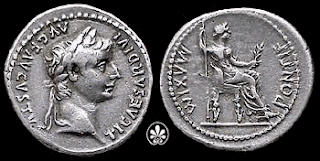
Matthew 12:15-22 What does Jesus mean when he says that we should ‘give to the emperor the things that are the emperor’s, and to God the things that are God’s’? Has he just answered a difficult question in a way that gets him out of trouble, but doesn’t actually say anything. It is a very clever answer to a difficult question that is designed to stitch Jesus up. They asked him, ‘Should we pay taxes to the emperor?’ The tax that they were speaking about was a poll tax, a charge that was levied by the Roman authorities on every individual. When you paid your poll tax, it was usually when there were Roman soldiers around, and you knew that you lived in an occupied land. So, if Jesus says, ‘yes, we should pay taxes’, then he is spiritually hopelessly compromised. For a Jew there were so many reasons why they should not pay the tax. There was national pride. Quite a significant number of people had chosen armed rebellion. They read in their history, from the boo...

Growing in our knowledge of God. A talk for the parish AGM

Colossians 1.3-14 Paul begins his letter to the Colossian Christians by thanking God for them, by thanking God for the gospel, and by praying that they would be filled with the knowledge of God’s will. And that seems to me to be a good model to follow on an occasion like this. 1.       I do thank God for you – for your faith in Jesus and your love for all the saints. It is encouraging to see the faith that so many have. It has been great to see people taking new steps of faith: taking risks and doing things like Café church and Sunday@4; or taking on new jobs or becoming Readers in the Church of England, as Tom and Andrew did. And it has been a particular privilege for me this last year to be beside several of our brothers and sisters as they have faced death with the Lord.  And some of them have been quite inspirational.       And it is encouraging to see the love that people have for all the saints. ...

A different kind of religion

Philippians 3.1-11 I went on a website which asks what, in a secular world, takes the place of religion today? Among other things, people mentioned: political affiliation, health foods, fitness, motorbikes, gaming, music (specifically, the Beatles and One Direction!), social media. The big one was Sport. But I guess our 'religion' can also be all those things in which we put our confidence, things such as status, success, hard work, money, our moral standing, education, fitness, family etc. Paul, the writer of Philippians, was clearly immensely able. He had a brilliant mind, the equivalent of a top Oxbridge or Harvard graduate. And he had all the credentials that would have given him great status in the society in which he lived. In Philippians 3, Paul speaks about some of the things in which he could have put his confidence: He had been through the right rituals He was of the very best family His doctrine was utterly sound. He was committed, zealous and he worked...

Be holy, be hopeful, be humble

2 Peter 3.11-18 listen to ‘Be holy, be hopeful, be humble’ on audioBoom What sort of lives should we live? I wonder what you will end up doing? Astronaut, lawyer, vicar, retail manager, musician, footballer, engineer, writer, inventor, nurse. It is fascinating: and I look forward to finding out. But Peter asks a slightly different question: not what will you do, but what sort of person will you be? What will be your character? It is more important. Because we are bigger than what we do. We are how we live. So what sort of people should be like? Holy, Godly, People with a hope, Active, Humble, Grow and mature, people who bring glory to God.  I’m just going to focus on three.  1. Holy people Peter writes: ‘What sort of persons ought you to be in leading lives of holiness and godliness … without spot or blemish’. That sounds so boring. We think of holy people as pious and aloof, sitting cross legged on some mountain somewhere. It is ...