Posts

Showing posts with the label ravenna mosaics

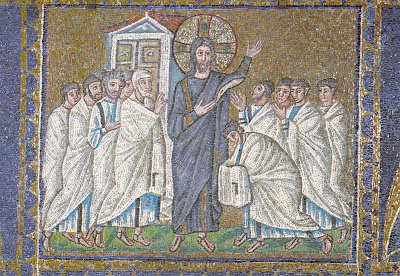
My Lord and my God

Image
John20.24-29 Today we are looking at the last in the cycle of very early C6th mosaics that can be found in the church of St Apollinare Nuovo in Ravenna, which depict the life, death and resurrection of Jesus.  We see Jesus appearing to the 11 disciples. This is the second meeting that the resurrected Jesus has with his disciples – a week after his appearance to them on the first Easter Sunday. Jesus is showing his wound (we only see the wound on his side, presumably where he was stabbed with the spear), but in so doing he points us to our right. All the way through this cycle of 26 mosaics, there has been a movement to our right. In most of the mosaics, one of the figures moves us on to the next. Now here at the end, Jesus himself moves us on, but this time upwards, to heaven. On the first occasion when Jesus appeared to his disciples, Thomas was not present. And when the disciples told Thomas that they had seen the Lord, Thomas made his famous statement: ‘Unless I s...

What communion means.

Image
Luke 22.14-23 We have now moved from the left to the right hand side of the church of St Apollinare Nuovo. We are not going to look at all of the 13 mosaics on this side, but as we prepare to remember the events of the first Good Friday and Easter, we will look at some of these mosaics which focus on Jesus' journey to the cross There is an immediate difference between the mosaics on the left and on the right: The Jesus on the left is beardless and the Jesus on the right has a beard. There is a debate about why! Most seem to say that beards were a mark of maturity - or a mark of grief. It is the mature Jesus who goes to the cross. There is also a different style. The mosaics on the left hand side of the church are simple, quite iconic, usually showing Jesus with one subject and one disciple. The mosaics on the right are more complex. There are multiple figures. And today we are going to look at this image: Jesus is reclining at the table, together with his 12 disciples. Four o...

On our face before Jesus

Image
Luke 8.40-56 Of all the mosaics in St Apollinare Nuovo, Ravenna, this is the one that got to me the most. It shows a woman fully covered at the foot of a man. Apart from the man in blue, none of the other figures are paying her any attention. Indeed one seems to be saying, with the gesture of his hand, ‘walk on by’. The man in blue (no prizes for realising it is Jesus – the halo is a bit of a give-away) is, however, bending toward her and appears to be reaching out his hand to her. It is an image which today is quite shocking. That is because we have learnt to see individuals not as individuals but as representatives of groups, especially groups that can make some claim to be victims. So this woman could be seen as a representative of oppressed and crushed women everywhere. It reminds us of women compelled to wear hijabs, and of the utter disregard for human rights that are shown women in some countries. But lest we think that is all ‘their’ problem, the reality is tha...

The widow who gave all that she had

Image
Mark 12.41-44 This is the fourth picture that can be found on the walls of the church of St Apollinare Nuovo, Ravenna. It is a portrayal of the incident recorded in Mark 12.41-44. So there is the chest, the widow, Jesus and a disciple. I came across a new interpretation of this passage. In the previous verses we have been warned about the teachers of the law: ‘They like to devour widow’s houses’ (v40).  And now we read of a widow who has to put everything that she has into the temple collection box. Jesus' is challenging a religious system which exploits the poor. While I think that we need to hear that challenge, I am not convinced that this is what is going on here. The widow’s giving appears to be completely voluntary. And Jesus points to her as an example of giving. My own view is that Jesus is teaching us here what it means to follow him, about discipleship. The contrast here is not between the teachers of the law and the widow. It is not even betw...

The healing of the man at the pool: a reflection on the mosaic from S. Apollinare Nuovo, Ravenna

Image
John 5.1-18 We are  beginning a series looking at incidents from the life of Jesus. The incidents which we are choosing are incidents which are portrayed in the earliest known set of images from the life of Jesus. They are in the church of St Apollinare Nuovo, in Ravenna.  Ravenna, in NE Italy, is an amazing city. It is completely off the tourist map, and yet it contains 8 world heritage sites. Those include the church of St Vitale, and the church of St Apollinare, not to mention two baptisteries.  Ravenna is significant because between 400 and about 550 it was the most important city in the Western Empire after the fall of Rome. The Christian architecture and the art was influenced by both East and West, by Rome and Constantinople (today’s Istanbul), the residence of the senior Patriarch of the Eastern churches. And while virtually all of the early Christian art in Constantinople, Jerusalem and the East was destroyed in the iconoclasm of the 700s and 800...