Posts

Showing posts with the label church

What is Anglicanism?

Image
The Anglican Church has about 85 million members in 39 Provinces across 165 countries. The average Anglican, as the current Archbishop of Canterbury often says, is not someone from the UK, but a 30-year-old woman in Africa who is earning under $1 a day. It is a family of Churches, a fellowship or communion of Churches, which grew out of the Church of England, with shared saints, linked histories, theology, worship and a shared relationship to the Archbishop of Canterbury. So what is Anglicanism? What does it mean to be an Anglican? BEING PART OF THE ONE CATHOLIC CHURCH There is a continuity with the past A maintenance of the three-fold order of bishops, priests and deacons. An unbroken link through time and space with the apostles, and a very early ordering of the Church. Confession of the historic creeds: Apostles, Nicene and Athanasian Celebration of the sacraments: and particularly Baptism and Holy Communion Use of liturgy, rites and prayers which reach back to the...

When God is at home in his Church

Image
EPHESIANS 2.11-22 This is a complicated passage, and I confess that I have really struggled with it. It is about the unity that Christian believers have when we are in Christ, and it can be divided up into three sections. 1. Paul tells us what we were without Christ (2.11-12) We were not part of the people of God He is speaking to people who were not Jews.  4000 years ago God chose the Jewish people to be his people. He said he would be their God and they would be his people. He gave them his law. And he said that through his people all people would be blessed.  But as Gentiles, as non-Jews, Paul is saying to his listeners, you were not part of the people of God.  And we were at war with God.   We chose to live without God, as rebels against God, enemies of God.  I was wilfully blind and deaf when it came to the things of God, because I wanted to live life my way and to satisfy my own desires.  Yes, we might have spent...

Learning how to disagree graciously

Romans 14.1-12 listen to ‘How to disagree graciously’ on Audioboo This is one of those passages which, when we first read it, we think ‘what on earth is going on’, but then discover that there is so much for us. The issue that was tearing the church in Rome apart at the time was the question of special days and food. There were some Christians, probably from a Jewish background, who were vegetarian. This was probably not a health decision, or a decision made because of the inhumane treatment of animals. It was a decision that was made because most meat sold in the market had been slaughtered in pagan temples and dedicated to pagan Gods, and so many people felt they could not eat it.  And these Jewish-Christians also wanted to keep special Jewish days. They said Jesus is the Messiah who came to fulfil the law, so all those special days that we had as Jews – the fast days and the feast days, and the Sabbath – are still special, and we want to observe them. ...

How to live as a united church.

Image
Ephesians 4:1-16 The book of Ephesians encourages  us to look at  other people  with completely different eyes.  On one side there were the  Jews On the  other side you have Gentiles Paul is saying that now, in Jesus, who was a Jew,  but who died on the cross and then rose again,  there is a new way of being, a new way of living. If you are with Jesus, you are no longer to identify yourself as a Jew, or as a Gentile – but as a new person . ‘His purpose was to create in himself one new person, out of the two, thus making peace’ (Ephesians 2:15) And you will realise that what Paul is saying here about Jew and Gentile can  equally  be applied to all our human distinctions – black/white, male/female, lived in Bury all life/newcomer, English/Scottish , Academy (two tier)/KEGS (three tier) When we are with Jesus, we  are no longer Jew/Gentile. We  become new people with a new  identity, a new purpose, ...

God's new community

Image
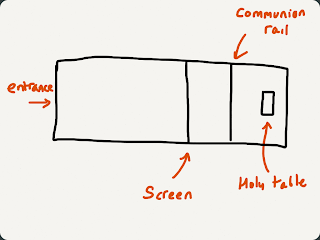
Ephesians 2:11-22 Often people will say when they come into this building, ‘What an amazing church’. I usually reply, slightly provocatively, ‘Yes, it is an amazing church, and the building is quite impressive as well’. The New Testament understands that the Church is the people, and it was only later that the word ‘Church’ also came to mean the place where the people met. Every month before attending my Bible study at church, I would tell my 3-year-old son, Chad, we were going to God's house. Each time we walked through the quiet sanctuary on our way to the nursery, Chad looked around in awe. One particular day, he stopped abruptly and asked, "Mummy, if this is God's house, how come He's never home?" But what I’d like to do this evening is to use this building as my visual aid for helping us understand what Paul is saying here about the church, the people of God. In the previous verse, Paul has been speaking of how we have been saved. It ...